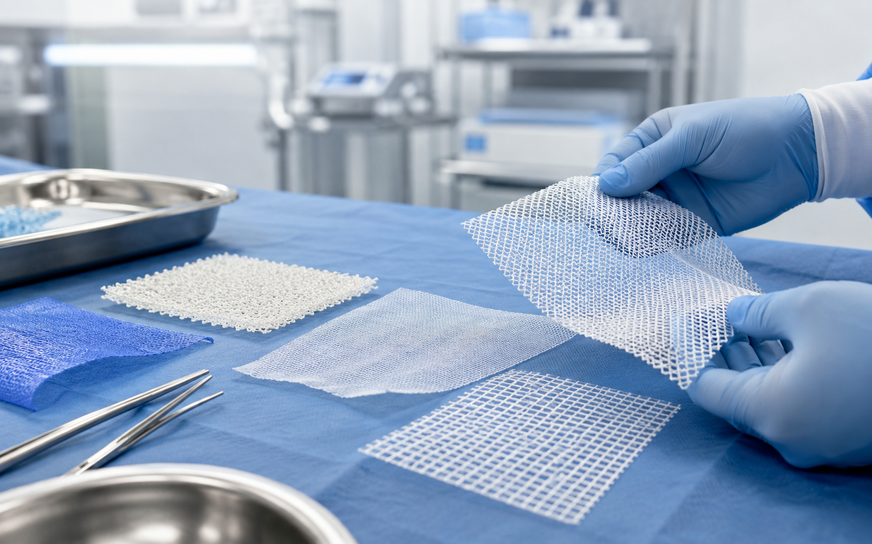
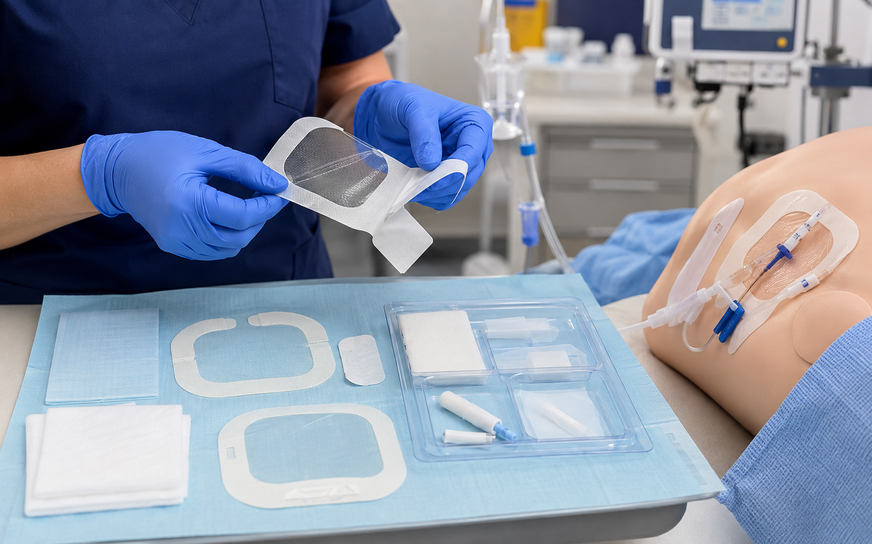
When managing heavily draining wounds, dressing selection directly affects healing outcomes, wear time, and the risk of periwound maceration. A hydrofiber wound dressing — most commonly built on carboxymethylcellulose (CMC) gelling fiber technology — absorbs exudate and converts it into a cohesive gel that stays locked within the dressing structure. A CMC wound dressing in this format is designed to minimize leakage, maintain contact with the wound bed, and support longer wear intervals even when drainage is heavy. Calcium alginate offers a different but overlapping profile. This guide compares both from a practical clinical and procurement perspective.
Hydrofiber Wound Dressing vs. Alginate: How Each Handles Heavy Exudate
Both dressing types are designed for moderate-to-heavy exudate, but they handle fluid differently — and that difference matters in clinical practice.
Material Behavior Comparison
| Property | Hydrofiber / CMC Wound Dressing | Calcium Alginate |
|---|
| Fiber origin | Synthetic CMC (carboxymethylcellulose) | Natural seaweed-derived calcium alginate fibers |
| Gel formation | Absorbs and forms a cohesive, bound gel mass | Forms a softer, more dispersed gel on contact with wound fluid |
| Fluid retention | High — exudate locked within gel structure | High — but gel is less cohesive; more lateral spread possible |
| Vertical wicking | Strong — fluid drawn upward into dressing | Moderate — varies by product construction |
| Conformability | Excellent — softens and molds to wound contours | Good — fibers conform but gel can be less uniform in irregular beds |
| Hemostatic property | Not primary function | Yes — alginate has natural hemostatic properties useful in bleeding wounds |
Where Each Performs Best
| Clinical Scenario | Better Choice | Reason |
|---|
| Highly exudative flat wound with maceration risk | Hydrofiber / CMC | Cohesive gel locks fluid away from periwound skin |
| Bleeding wound or donor site | Calcium alginate | Natural hemostatic property provides additional benefit |
| Fragile wound edges requiring gentle removal | Hydrofiber / CMC | Cohesive gel removes as one piece with reduced trauma |
| Cavity or sinus requiring conformable packing | Both — rope format | Product-specific gel behavior determines preference |
| High bioburden wound requiring antimicrobial option | Both — check variant | Antimicrobial versions available in both categories |
CMC Wound Dressing Performance: Exudate Lock-In, Conformability, and Wear Time
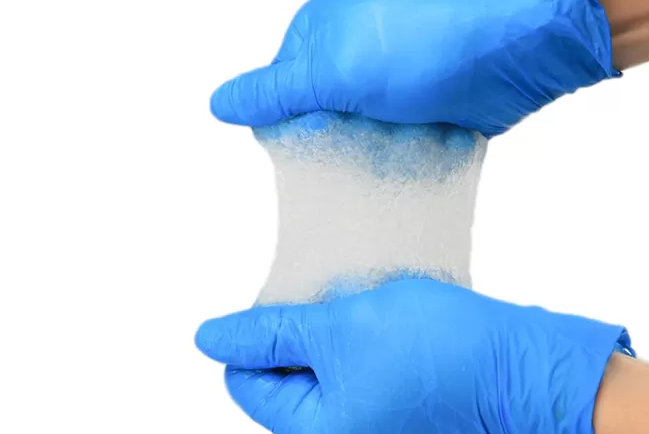
The defining clinical advantage of a CMC wound dressing is what happens after fluid absorption — the gelling fiber converts exudate into a structured, cohesive gel mass rather than simply saturating and spreading it.
What Gelling Fiber Behavior Means in Practice
When CMC fibers absorb wound fluid, they swell and interlock, creating a gel that holds the exudate in place rather than allowing it to migrate laterally toward periwound skin. This vertical wicking and lock-in mechanism is the primary reason CMC-based hydrofiber dressings are selected in high-drainage scenarios where maceration is a concern.
Clinical Indications
| Wound Type | CMC Dressing Suitability |
|---|
| Moderately to heavily exuding chronic ulcers (venous, diabetic, pressure) | Well indicated |
| Post-surgical wounds with active drainage | Well indicated |
| Traumatic wounds with irregular drainage patterns | Well indicated |
| Donor sites and split-thickness graft donor areas | Indicated — check product IFU |
| Dry or minimally exuding wounds | Not indicated — insufficient fluid to activate gel mechanism |
Wear Time and Secondary Dressing
CMC wound dressings are primary dressings. They require a secondary cover to secure the dressing, manage any strike-through, and protect the periwound environment. Wear time varies by exudate volume — highly draining wounds may require daily changes early in treatment, with frequency reducing as drainage decreases. Always follow the product's instructions for use and local clinical protocols for specific change interval guidance.
Hydrofiber Wound Dressing vs. Alginate in Cavities: Packing, Removal, and Residue Risk
Cavity and sinus wounds introduce a different set of requirements — the dressing must fill dead space, maintain contact with the wound base and walls, and come out cleanly at the time of change.
Sheet vs. Rope Format
| Format | Best Application | Key Consideration |
|---|
| Sheet | Flat, shallow wounds with even wound bed | Trim to wound size; do not overlap onto periwound skin |
| Rope / ribbon | Cavities, tunnels, sinuses, undermined edges | Pack loosely — do not pack tightly as this impairs drainage and can cause pressure |
Removal Integrity — Why It Matters
One of the primary clinical concerns with cavity dressings is incomplete removal — fiber residue retained in a wound can act as a foreign body and impede healing. This is where the cohesive gel structure of a CMC wound dressing provides a practical advantage: the entire dressing tends to come out as one retrievable mass rather than fragmenting. Calcium alginate gels are softer and can break apart more readily, particularly in deep cavities.
Clinical Caution Points
Never pack a cavity tightly — leave room for gel expansion as fluid is absorbed
Always count dressings in and out in cavity applications, particularly tunnels
Protect periwound skin with a skin barrier film or wipe before applying any gelling fiber dressing
Confirm the dressing length used on the care record for cavity applications to support safe removal
CMC Wound Dressing Procurement Checklist for 2026
For hospitals, wound care clinics, and distributors evaluating gelling fiber dressings, a complete specification reduces post-delivery disputes and supports formulary decisions.
Product Specification Checklist
| Specification | What to Define | Why It Matters |
|---|
| Size range | Sheet sizes (e.g., 5x5, 10x10, 15x15 cm) and rope dimensions | Covers wound size variation across patient population |
| Format | Sheet only, rope only, or both | Flat wound and cavity applications require different formats |
| Sterile packaging | Individual sterile pack — confirm integrity standard | Clinical safety requirement; shelf life confirmation |
| Shelf life | Minimum remaining shelf life at delivery | Procurement planning for high-usage departments |
| Absorbency rating | Defined fluid handling capacity per unit area | Supports formulary comparison and clinical matching |
| Antimicrobial variant | Silver or other antimicrobial option available? | Required for infected or high-bioburden wound protocols |
Documentation Requirements
| Document | Purpose | Market Applicability |
|---|
| Certificate of Analysis (COA) | Confirms product meets specification per batch | All markets |
| CE marking documentation | Confirms compliance with EU Medical Device Regulation | EU and EU-aligned markets |
| FDA 510(k) clearance or registration | U.S. market access documentation | USA |
| ISO 13485 certification | Quality management system for medical devices | Global procurement; often required by hospital procurement departments |
| Instructions for Use (IFU) | Clinical use guidance; required for regulatory compliance | All markets |
Hydrofiber Wound Dressing Decision Guide: When CMC Wins and When Alginate Wins
The honest answer is that both dressing categories are appropriate for highly exudative wounds — the decision depends on wound characteristics, clinical priorities, and the available product formulary.
Decision Matrix
| Wound Characteristic | Choose Hydrofiber / CMC | Choose Calcium Alginate |
|---|
| Very heavy exudate with maceration risk | Yes — cohesive gel locks fluid away from skin | Possible — depends on product's lateral spread behavior |
| Fragile wound edges or periwound skin | Yes — gentler removal due to cohesive gel | Use with care — confirm removal protocol |
| Actively bleeding wound | Less indicated | Yes — hemostatic property is an advantage |
| Deep cavity or sinus | Yes (rope format) — cohesive removal | Yes (rope format) — widely used; check fragmentation risk |
| Flat chronic ulcer with heavy drainage | Yes — strong clinical evidence base | Yes — appropriate if drainage volume matches product capacity |
| High bioburden or infected wound | Yes with antimicrobial variant | Yes with antimicrobial variant |
| Low exudate wound | Neither — incorrect indication for both | Neither |
When to Choose Hydrofiber / CMC
The CMC wound dressing is typically the stronger choice when exudate volume is high and the clinical priority is minimizing periwound maceration, achieving longer wear intervals, or ensuring clean one-piece removal from a cavity. The cohesive gel structure is the differentiating mechanism.
When to Choose Alginate
Calcium alginate is well matched to heavily draining wounds where the hemostatic property provides additional benefit — donor sites, traumatic wounds, post-procedural bleeding — and where the softer gel behavior is acceptable given the wound geometry and change frequency. As professional alginate dressing manufacturers, JCMED provides alginate solutions for various wound care needs.
Conclusion
For highly exudative wounds, both hydrofiber and calcium alginate dressings are clinically appropriate options — the best choice depends on wound depth, drainage volume, periwound fragility, and your formulary and protocol context. When the priority is strong exudate binding, cohesive gel formation, and reduced maceration risk, a hydrofiber wound dressing in a CMC wound dressing format is frequently the first choice for clinicians managing heavily draining chronic and acute wounds.
FAQ
Q1: Is a hydrofiber wound dressing the same as a CMC wound dressing?
Many hydrofiber-style gelling fiber dressings are based on carboxymethylcellulose fibers — so the terms are often used interchangeably in clinical and procurement contexts. The defining characteristic is the gelling fiber mechanism: CMC fibers absorb wound fluid and form a cohesive gel. Always confirm the fiber composition with the manufacturer and review the product's instructions for use for clinical indication guidance.
Q2: Which is better for highly exudative wounds — hydrofiber or calcium alginate?
Both are designed for moderate-to-heavy exudate management. Hydrofiber or CMC dressings tend to offer stronger fluid lock-in and more cohesive gel formation, which is advantageous when maceration risk is high or clean cavity removal is a priority. Calcium alginate has a natural hemostatic property that makes it preferable in bleeding wounds. Clinical context, wound type, and local protocol should guide the final decision.
Q3: Do hydrofiber and alginate dressings need a secondary dressing?
Yes, in most applications. Both are primary dressings that require a secondary cover to secure placement, manage strike-through exudate, and protect the periwound area. The secondary dressing choice depends on exudate volume, wound location, and the need for compression or offloading.
Q4: Can these dressings be used on dry wounds?
Generally not. Gelling fiber and alginate dressings are activated by wound fluid — without sufficient exudate, the gel mechanism does not engage and the dressing provides no functional benefit. Dry or minimally exuding wounds typically require moisture-donating dressings such as hydrogels or hydrocolloids. Always follow local clinical guidelines and the product's instructions for use.
Q5: What are the most important considerations when bulk-buying CMC wound dressings in 2026?
Consistent gel performance across batches, sterile packaging integrity with adequate remaining shelf life at delivery, availability in both sheet and rope formats to cover flat and cavity indications, full regulatory documentation for your target market (CE, FDA, ISO 13485), and reliable supply continuity for high-usage wound care departments.