Vaseline gauze is a familiar product in hospital dressing rooms, first-aid kits, and distributor catalogs, but its role is often described too broadly. It is not primarily an absorbent pad. It is an impregnated wound-contact layer designed to reduce direct adhesion between dry gauze and the wound surface while allowing fluid to pass toward a secondary dressing when required.
The product may also appear under names such as petrolatum gauze, paraffin gauze, petroleum-impregnated gauze, or vaselinized gauze. These terms are closely related, but they should not be treated as proof that two products have identical formulations. Medical buyers still need to confirm the impregnation material, mesh construction, sterile status, package format, and intended use of the exact item being quoted.
How Does Vaseline Gauze Work?
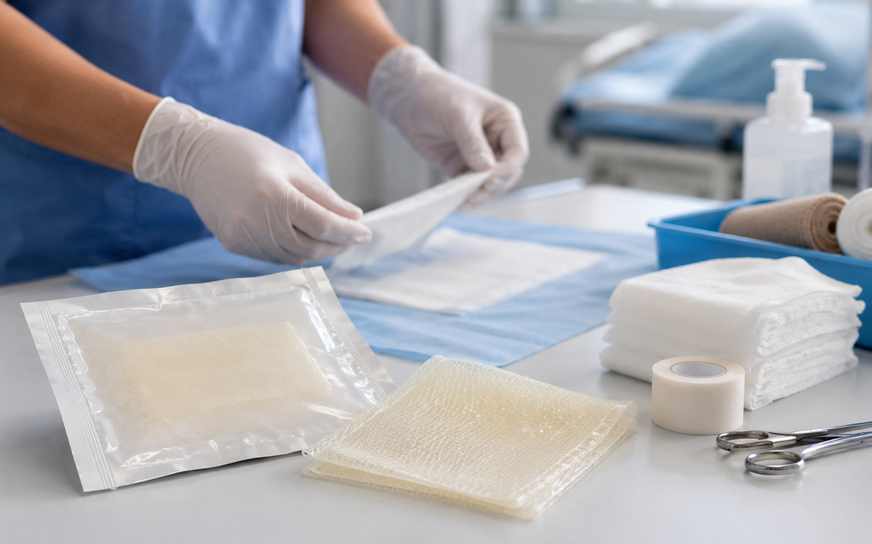
Traditional dry gauze can become attached to a wound as fluid dries within the fibers. Vaseline or petrolatum impregnation creates a less adherent interface. The open weave allows some fluid to move through the dressing instead of remaining trapped directly against the wound.
This is why a vaseline gauze occlusive dressing should be evaluated as part of a complete dressing system. If the wound produces fluid, the contact layer may need to be covered with a secondary absorbent dressing and secured according to the product instructions and professional protocol.
Performance can vary according to:
The petrolatum or paraffin formulation
The amount of impregnation applied to the gauze
The openness and density of the mesh
The finished pad, strip, or sheet size
The sterilization method
The individual pouch and shelf life
Common Procurement Applications
Depending on the approved instructions, impregnated gauze may be included in product programs for selected superficial wounds, minor burns, donor sites, postoperative sites, and first-aid applications where direct adhesion of dry gauze is undesirable.
| Application | What the Buyer Should Confirm |
|---|
| Superficial wound contact | Mesh, impregnation, size, sterility, and replacement guidance |
| Burn-care supply program | Approved intended use, secondary dressing, and warning information |
| Hospital dressing packs | Individual pouch, pieces per box, carton quantity, and shelf life |
| First-aid kits | Compact package size, labeling language, and kit compatibility |
| Distributor inventory | Available sizes, repeat-order schedule, and product documentation |
This table is intended for purchasing reference. Clinical suitability must be determined from the product instructions and qualified wound-care practice.
Vaseline Gauze vs Paraffin Gauze
In some markets, the two names are used almost interchangeably. In others, they may refer to different ointment bases or coating specifications. A buyer should compare the technical details rather than relying only on the commercial name.
Useful questions include:
Is the gauze impregnated with petrolatum, paraffin, or another material?
What is the mesh construction?
Is the dressing supplied sterile and individually packed?
Does the product require a secondary absorbent layer?
Which sizes and package configurations are available?
What intended uses are listed in the instructions?
What Should Distributors Request Before Ordering?
Professional buyers should request a product-specific document pack. A broad statement about wound-care quality is not enough because formulation, labeling, sterilization, and registration may vary between products.
When comparing medical dressing manufacturers, include the following details in the RFQ:
Required product name and destination-market terminology
Impregnation material and coating specification
Finished size and gauze mesh
Sterile or non-sterile format
Individual package and carton quantity
Storage conditions and remaining shelf life
Required certificates or registration documents
Standard packaging or private-label requirement
A reliable medical dressings wholesale supplier should be able to separate confirmed product facts from general category claims and explain which documents apply to the exact dressing.
Common Purchasing Mistakes
One common mistake is selecting the product only by dimensions. Two dressings with the same nominal size may differ in coating, mesh density, pouch construction, sterile status, and handling.
Another mistake is treating Vaseline gauze as a highly absorbent dressing. Its primary role is contact-layer protection. When fluid management is required, a suitable secondary product may still be necessary.
Buyers should also avoid accepting unsupported promises such as faster healing, painless removal, or infection prevention unless those claims are supported for the exact model and market.
Conclusion
Vaseline gauze is mainly used as an impregnated wound-contact layer that helps reduce direct adherence while allowing fluid to pass through its open mesh. Procurement decisions should be based on the formulation, mesh, size, sterility, package, intended use, and product-level documents rather than the product name alone.
Frequently Asked Questions
What is Vaseline gauze used for?
It is generally used as a low-adherence wound-contact layer in selected wound-care and first-aid applications, subject to the product instructions and professional protocol.
Is Vaseline gauze the same as paraffin gauze?
The terms are often related, but the exact impregnation material and specification may differ. Buyers should compare the formulation and technical documents.
Does Vaseline gauze absorb wound fluid?
It may allow fluid to pass through the mesh, but it is not normally the main absorbent layer. A secondary dressing may be required.
Can Vaseline gauze be private labeled?
Selected standard sizes may support private-label packaging, subject to minimum order quantity, artwork, documentation, and destination-market requirements.
References
Dhivya S, Padma VV, Santhini E. Wound dressings: a review. BioMedicine. 2015;5(4):22. Available at: https://pmc.ncbi.nlm.nih.gov/articles/PMC4662938/.
Sood A, Granick MS, Tomaselli NL. Wound dressings and comparative effectiveness data. Advances in Wound Care. 2014;3(8):511-529. Available at: https://pmc.ncbi.nlm.nih.gov/articles/PMC4121107/.