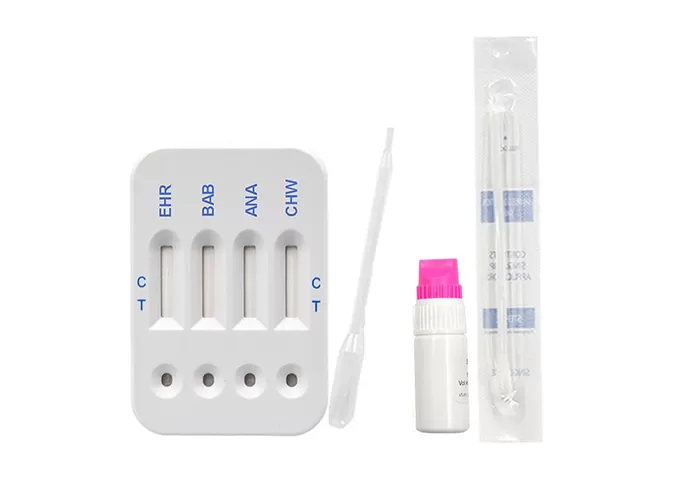
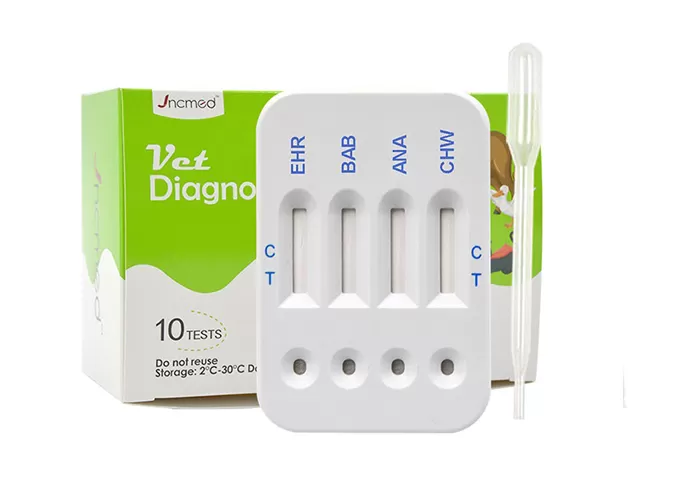
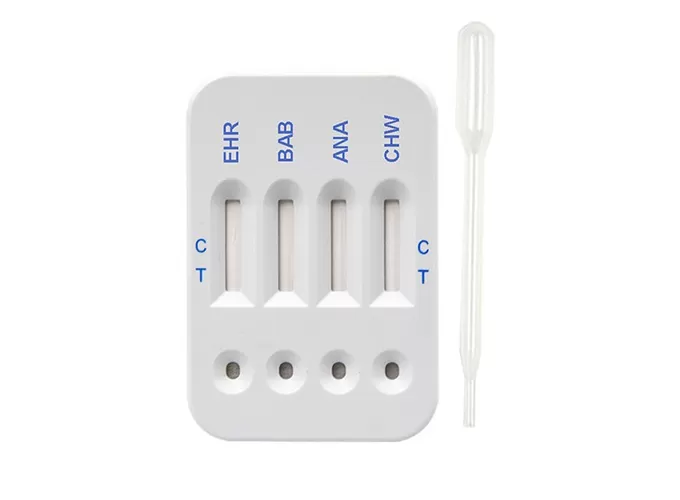
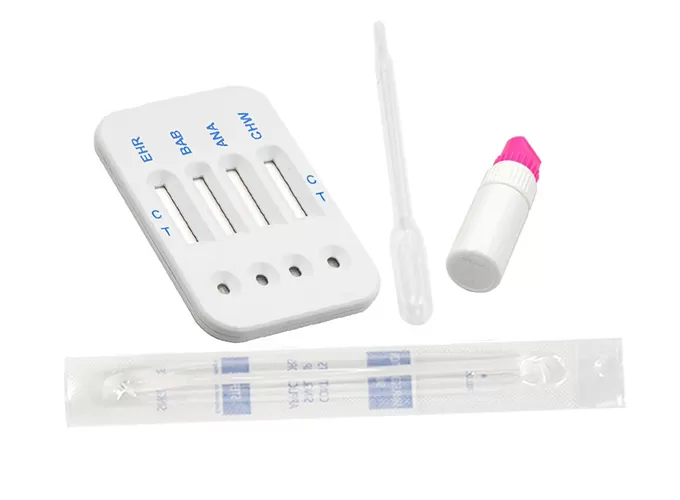
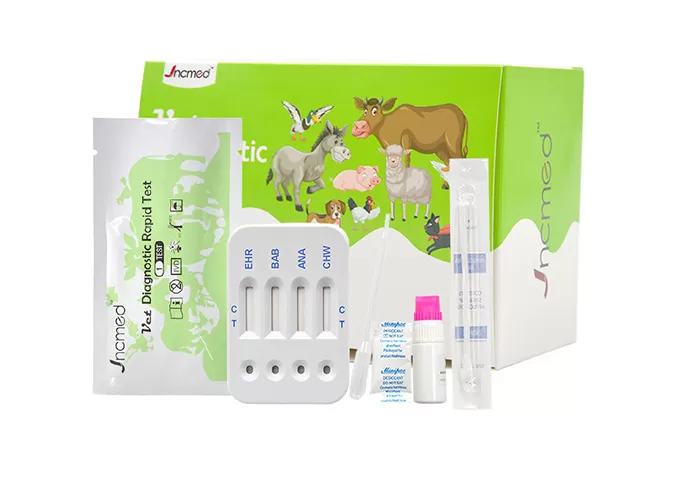
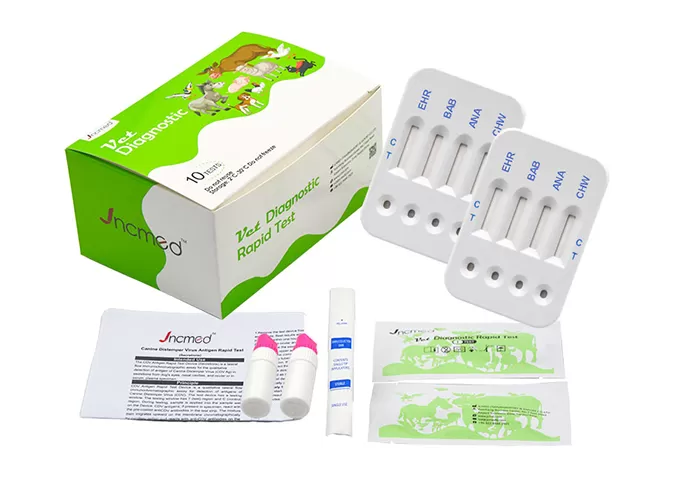
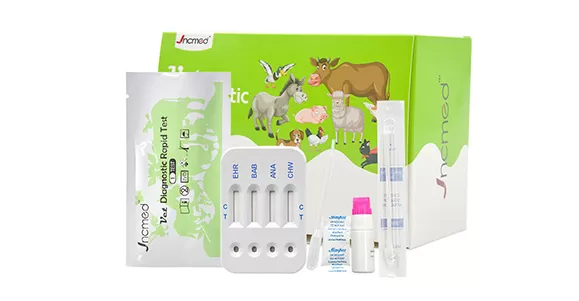
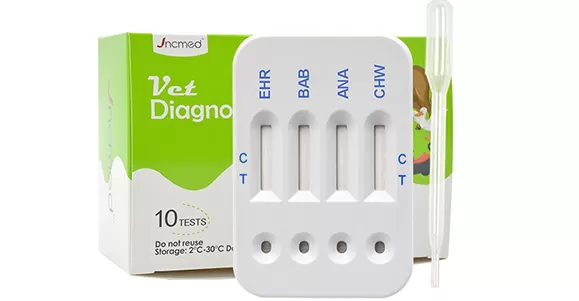


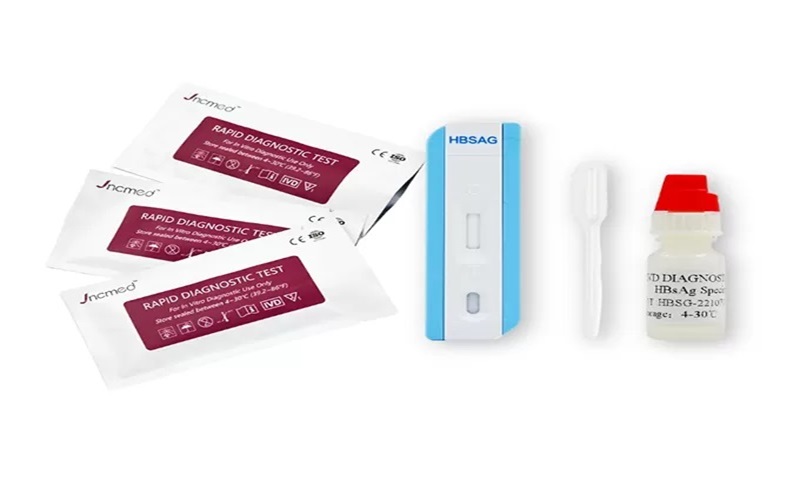
Ehrlichia canis (EHR) is an obligate intracellular parasite that is mainly transmitted by brown dog ticks (Rhipicephalus sanguineus), infects canine monocytes and granulocytes, and causes canine monocytic erlichiosis (CME). The disease is distributed globally and is particularly prevalent in tropical and subtropical regions. After infection, specific antibodies (EHR Ab) are produced in dogs, and their levels reflect the stage of infection: IgM antibodies increase in the acute phase (1-3 weeks), and IgG antibodies are dominant in the chronic phase (more than several months).
Detection of EHR antibodies is crucial for clinical diagnosis, especially for dogs with unexplained fever, anemia, thrombocytopenia, and multiple organ dysfunction. The lateral flow immunochromatography kit can quickly and qualitatively detect EHR antibodies in serum, plasma, or whole blood by pre-coating recombinant antigens. If antibodies are present in the sample, they will bind to the test line (T line) and develop color, and the results can be read within 15-20 minutes. The technology is easy to use and suitable for on-site screening, but it needs to be combined with PCR or blood smear microscopy for further diagnosis.
Early diagnosis and treatment (such as doxycycline) can significantly improve prognosis, while chronic infection may lead to immunosuppression and even death. Regular screening and tick control are the key to prevention.
| ltem | Relative Sensitivity | Relative Specificity |
| EHR Ab | 98.90% | 99.60% |
| Bab Ab | 100.00% | 97.50% |
| ANA Ab | 100.00% | 98.30% |
| CHW Ag | 97.90% | 98.10% |

Instructions for use
Please restore all materials (including samples and detection devices) to room temperature of 15-25℃ (if stored in a refrigerator, take them out in advance and equilibrate for 15-30 minutes).
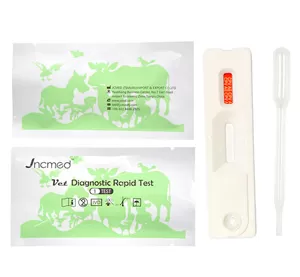
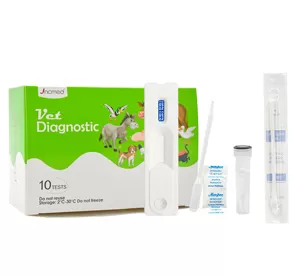
Take out the test card: tear open the aluminum foil package, take out the test card, and place it flat on a dry and clean table.
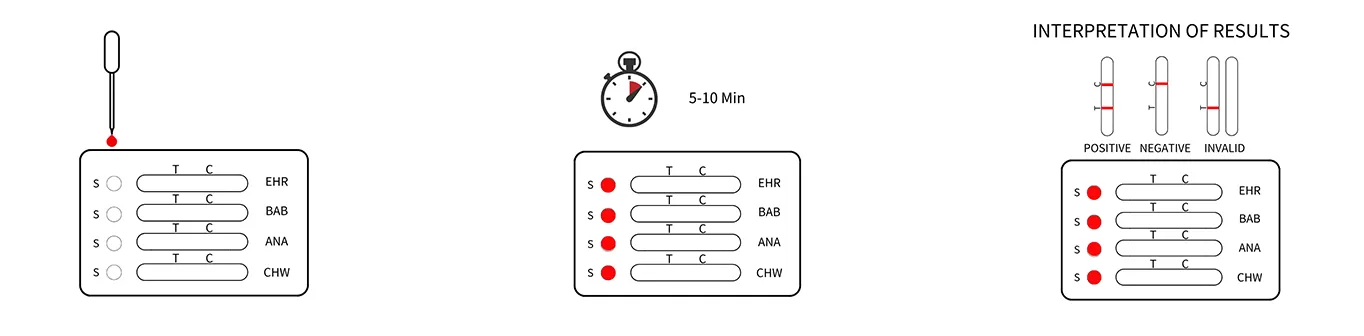
Use a dropper to draw 1 drop (about 10μL) of sample and drip it vertically into the sample well (S well).
Drop 3 drops (about 90μL) of detection buffer into each sample well).
Please read the results within 5-10 minutes. Results after 10 minutes are invalid.
Result interpretation
Effective conditions: Regardless of positive or negative, the control line (C line) must be colored, otherwise the test is invalid and needs to be retried.
Positive:
T line color (regardless of the color intensity of the C line): indicates that the sample contains the corresponding antibody (Ehrlichia/Babesia/Anaplasma) or antigen (heartworm).
Different pathogens correspond to independent T lines (some kits are designed for joint testing with a single T line, please refer to the instructions).
Negative: Only the C line is colored, and no band is visible on the T line.
Invalid: No colored line appears in C zone. No matter if T line appears.
Product Features
✅ Quadruple test: One test can screen four common canine pathogens, improving diagnostic efficiency.
✅ Fast and convenient: No complicated operation is required, and the results can be read in 15-20 minutes, suitable for clinical point-of-care testing (POCT).
✅ High sensitivity and specificity: High-quality recombinant antigens and antibodies are used to ensure detection accuracy.
✅ Applicable to a variety of samples: Supports whole blood, serum, and plasma samples to meet different testing needs.
✅ Intuitive interpretation: T line color is positive, C line is used as quality control, and the results are clear and reliable.
✅ Strong stability: The test kit is sealed and stored, with a long validity period, suitable for testing in different environments.
Applicable scenarios
Routine screening in pet hospitals and veterinary clinics
Health examinations and epidemiological surveys for dogs
Auxiliary diagnosis of dog infection symptoms (fever, anemia, emaciation, etc.)
Group health monitoring in kennels and stray animal rescue stations
Want to Get More Details About JCMED Medical Consumables?
We're waiting for your contact!